Decide what is worth changing in your company.
The technology has opened up new possibilities. An established business still needs to know which ones are useful and what they would cost to pursue. The Read is a close look at the actual operation, ending in a written recommendation you can act on.
$2,500
A written read within two business days.
A clear decision about what is worth proving.
A sound next decision, with the reasoning behind it.
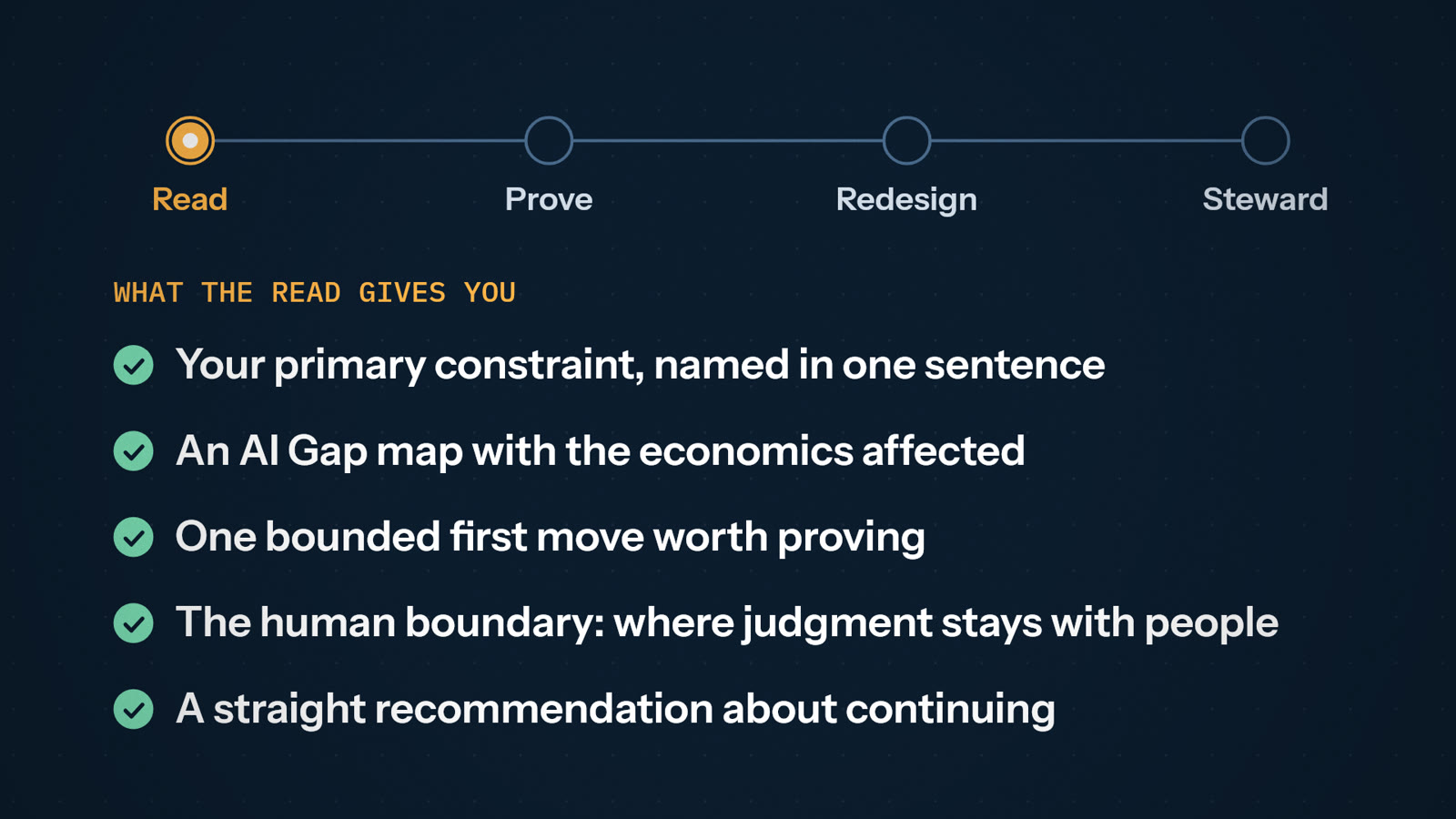
I examine an agreed area of your company, what would become possible with better systems and AI, and what making the change would really require. The written assessment names the main constraint, its economics and a first move worth testing.
| In the map | What it tells you |
|---|---|
| Today | How the examined workflows currently run, including the workarounds. |
| What causes the extra work | The recurring work, missing information or unclear responsibility that makes this process expensive. |
| What could work differently | What could be simplified, made dependable or handled with better software and automation. |
| Economics | Hours, delay, quality, capacity or revenue affected, with assumptions identified. |
| What still needs a person | Where judgment should remain with a person and what authority a system could receive. |
| First move | One bounded deployment worth proving, with a proposed measurement plan. |
| What it means for the business | What this change could mean for the company's capacity, costs or reliance on specific people. |
Start with the business decision.
Before the session, we agree which parts of the business to examine and which examples will help. You walk me through what happens, what it takes and where it relies on you.
For a one-person company, that means your own working day. With a team, the people doing the relevant work can help explain what the official process leaves out.
I use the five Business Nervous System functions to trace what the business can sense, communicate, understand, decide and check. Every finding needs an explanation.
The written read covers the agreed workflows and available evidence. Estimated economics are identified as estimates; the Prove stage establishes the baseline and measures the change.
A decision that stands on its own.
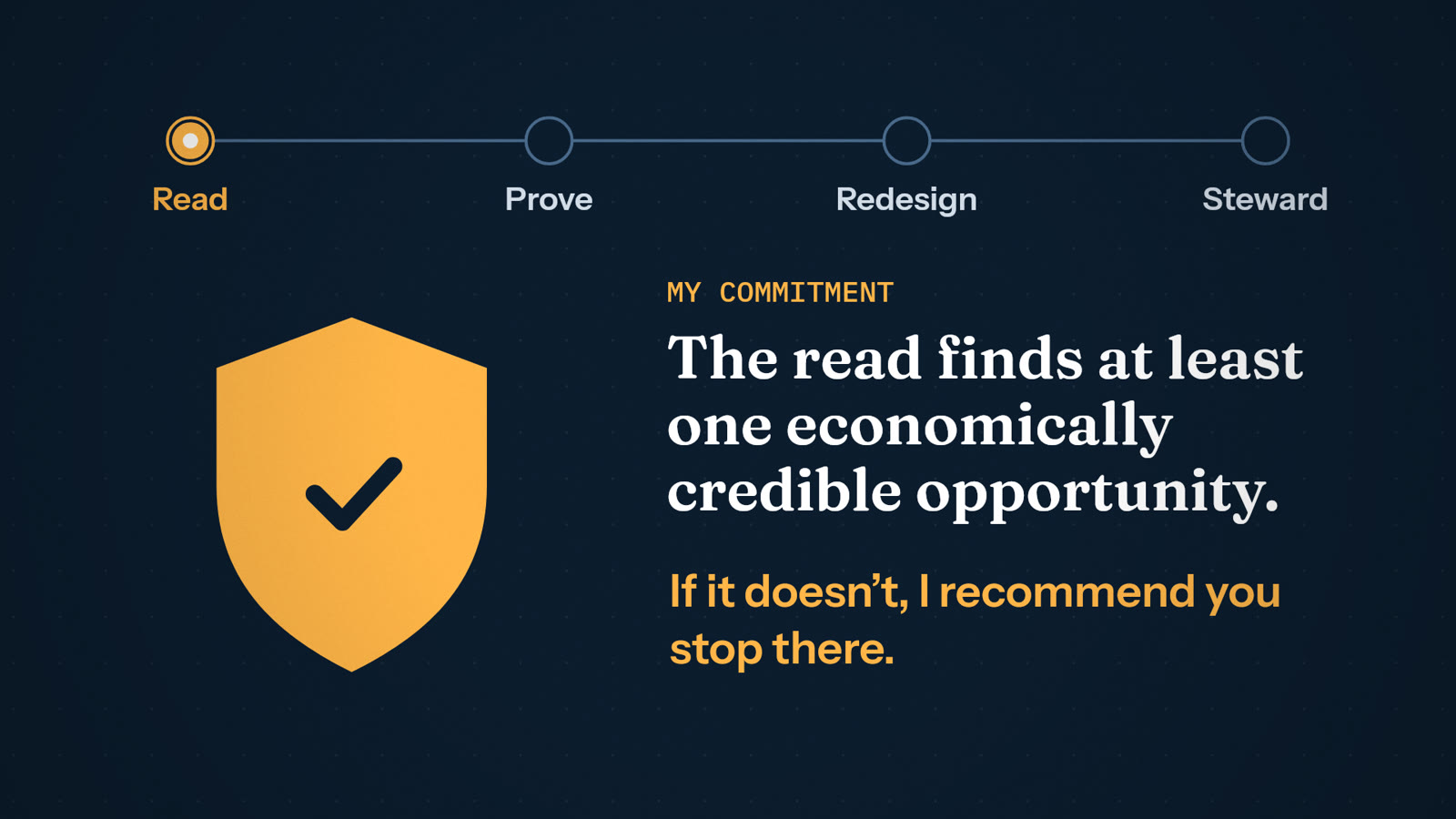
If the evidence supports a worthwhile improvement, I explain what to test first. If it does not, I will say so and recommend against further work with me.
You keep the written findings. Further work is a separate decision, with its own scope and price.
Follow a demonstration read.
The four published composite reads show how I connect operating evidence to a primary constraint and a proposed first change. The written Read also examines what modern software and AI make practical now.
Read the demonstrationsWhat should an AI workflow assessment tell you?
Is the read an AI readiness assessment?
The Read follows agreed workflows through the real business. It identifies where effort and value are lost, estimates the opportunity and recommends one sensible first change. The useful result is a decision about what to prove, supported by the context, economics and human boundaries involved.
What does the $2,500 include?
A 90-minute working session and a written read within two business days. You receive the findings and a recommended first move. Implementation and ongoing stewardship are scoped and priced separately.
Do I need clean data or a large team before starting?
No. We can examine where information is missing or unreliable; fixing that may be the first recommendation. The work is for established businesses doing $500k+ a year, including one-person companies.
What happens if AI is not the right first move?
I’ll explain the constraint and why I do not recommend continuing with an AI implementation. You keep the written findings. The read does not commit you to further work.
Still choosing where to begin? Read the guide to starting with AI.
Which opportunity are you trying to evaluate?
Send a little context. I’ll confirm fit, the scope of the read, payment and scheduling before the session.